
Managing a herd of 200 cows that graze while also being milked by robots is quite a challenge, admits Adriaan Bregman. Nevertheless, grazing was never up for debate for him and his father Jan when they switched to automatic milking in September 2022. “We manage 90 hectares of grassland, of which 55 hectares are home paddocks. It would be a shame not to take advantage of that,” says the dairy farmer. “We also notice that people in the area appreciate seeing our cows out in the pasture. We often receive positive feedback, and we enjoy it ourselves as well.”
Great feet and legs for robotic milking and grazing
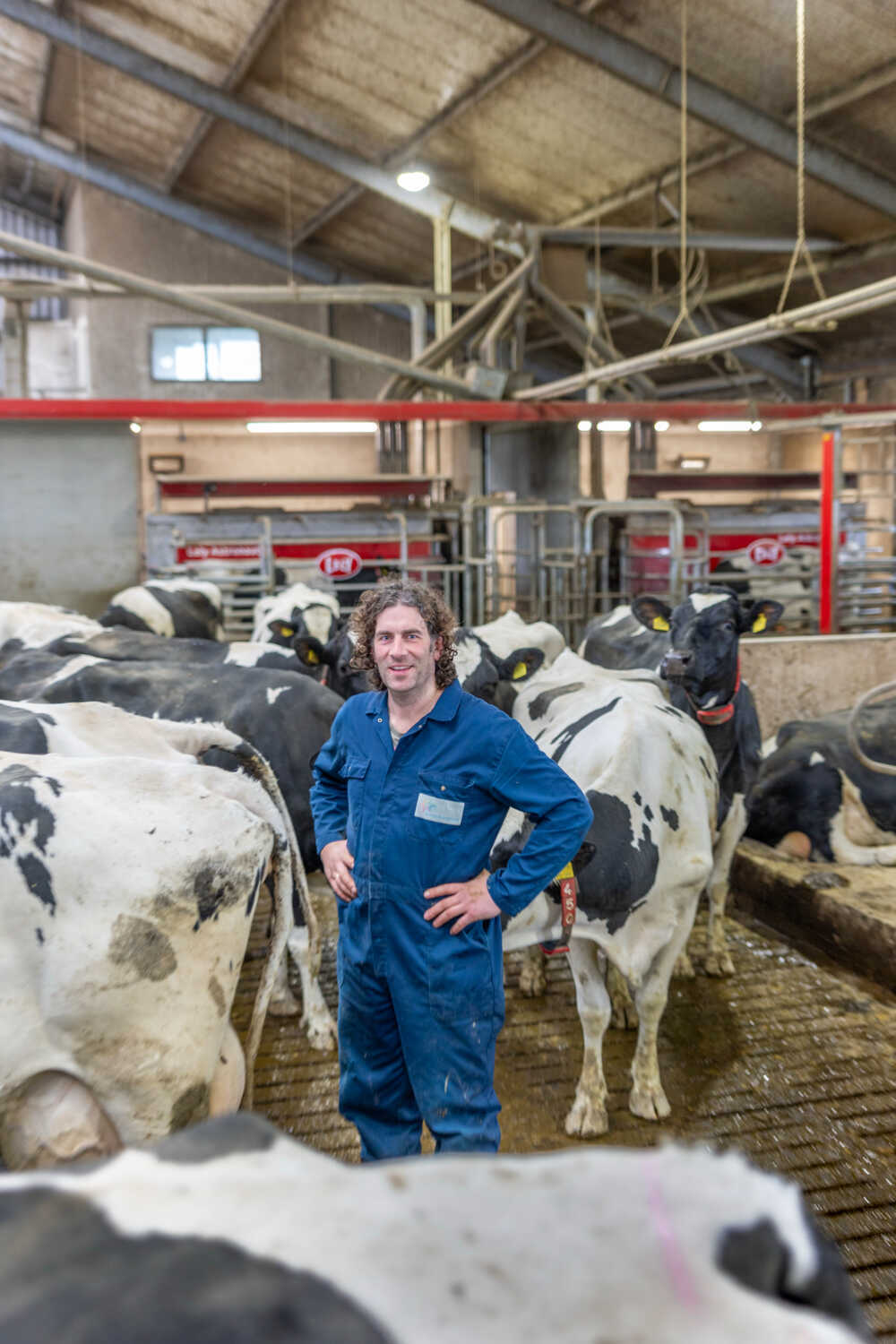
The Bregman family has put all the basics in place to successfully combine robotic milking with grazing. Breeding also plays an important role.
How can breeding help make robotic milking and grazing a success?
Getting the basics right
Father and son Bregman have taken many steps to create a solid foundation for a successful combination of robotic milking and grazing. They milk around 200 cows using four robots. “The overcapacity makes the system more flexible and makes grazing easier,” says Adriaan. In addition, the most frequently used grazing paddocks are equipped with permanent drinking troughs. When integrating the milking systems into the barn, careful thought was given to cow traffic to and from the pasture. In the 2+2 barn, the robots are located at the head end of the cubicle rows, with exits leading to a central walkway. From there, cows can leave the barn on either side.“ Cows have to pass through a robot before they are allowed into the pasture,” Adriaan explains. “They are allowed outside as soon as they’ve been milked or when there’s still enough time until their next milking. That way, we make sure no cows with full udders are out in the pasture.” About three hours after the first cows go outside, the barn is empty. “Then we open the entrance again. Because we use a system for on-demand feeding, feed is always available in the barn. Most cows return on their own, although in good weather with lush grass we sometimes have to fetch the last group,” the farmer says. He estimates that cows that graze an average of six hours per day consume around 6 kilograms of dry matter from grass. Intake is somewhat higher in the spring and lower in the fall. With an average of 2.8 milkings per day during the grazing season and a rolling annual average of approximately 10,800 kg of milk with 4.50% fat and 3.60% protein, the Bregman family is very satisfied.
Feet, legs and body codition
According to the dairy farmers from the northern part of The Netherlands, breeding also helps create optimal conditions for robotic milking and grazing. When making mating decisions, they combine genomic testing with individual cow breeding advice, SireMatch, and the aAa mating system. “We choose bulls with strong, all-round breeding values. The very highest production potential is less important to us. If cows are well built and healthy, production will follow naturally,” Adriaan states. Powerful leg use and healthy claws are, in his view, essential traits for smooth movement through the robots and to and from the pasture. Therefore, he makes no compromises on breeding values for these traits when selecting bulls. For breeding robot-suitable udders, he also considers udder traits such as teat placement and teat length. “Because pasture grass and weather conditions vary, we also select for body condition score. Cows with somewhat more reserves are better able to cope with fluctuations,” Adriaan says. Daughters of bulls such as Delta Perfect, Delta Lustrum, Double W Ranger, Delta Fast Lane and Delta Oneliner perform well within the Bregman family’s farming system. Perfect and Oneliner are still in use, and VVH Isaac Delta Gateway and Delta Amuse are also on the insemination list. Recently, young bulls such as VDR Spike and Weinterper Wodan have been added as well.
More information?
Do you want more information about breeding robot suitable cows and the CRV milking robot index? Check our previous article about the milking robot index here: More return with the milking robot index - CRV