
Determining breeding values for a calf only a few days old, at a higher reliability than for a cow that has calved four times, is now possible with CRV’s genomic testing. These tests provide information on breeding values for more than fifty traits, and give direct insight into A2A2 status, polledness, and hereditary defects. Parentage can also be verified through genomic testing.
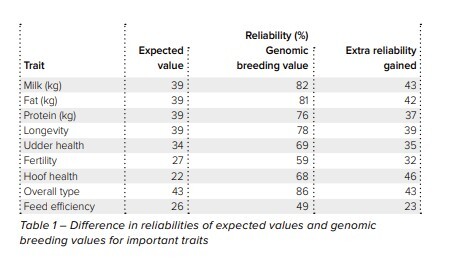
“Since genomic testing was introduced roughly fifteen years ago, reliability has increased significantly,” explains Jonas Perneel, information solutions specialist at CRV. The reliability of genomic breeding values now exceeds 80 percent for many traits. That is far higher than the reliability of traditional pedigree-based breeding values, also called parent averages. Table 1 shows the reliability of parent averages versus genomic breeding values for several key traits. “For most traits, genomic testing doubles the reliability of the breeding value,” Jonas emphasizes. “This means that farmers who use genomic breeding values can reliably select the animals that best match their breeding goals. Genomic testing also enables more precise mating decisions,” he adds.
Smart breeding doubles the benefits of genomic testing
Farmers who make breeding decisions based on genomic testing achieve greater genetic progress. But genomic testing becomes twice as valuable when the results are used to sharpen selection of breeding animals.
Breeding values twice as reliable
Sharper selection, faster progress
“By using animals with the highest breeding values for breeding, rapid genetic progress can be achieved, especially if the lowest-ranking animals are excluded from breeding by inseminating them with a beef bull,” Jonas continues. “Farmers can accelerate progress even further by using sexed semen on their very best animals,” he adds. “Sexed semen produces heifer calves from the top animals, and ensures enough replacement heifers, which allows more cows to be bred to beef bulls. This raises the selection pressure and speeds up genetic gain even more.”
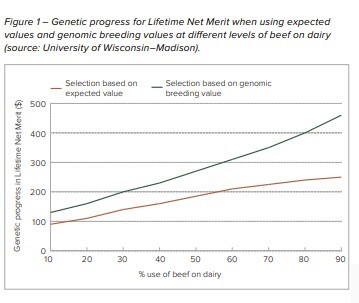
Jonas supports his advice with results from a study by the University of Wisconsin-Madison. The research calculated genetic progress for the U.S. economic index Lifetime Net Merit (profitability over a cow’s lifetime) when selecting based on parent averages versus genomic breeding values. The results are shown in figure 1.
Genetic progress doubled
"The results clearly show that selection based on genomic breeding values produces greater genetic progress than selection based on parent averages,” Jonas explains. “But even more striking is the advantage of targeted breeding with your best animals.”
Using only conventional semen, a farmer can inseminate a maximum of 30 percent of the herd with a beef bull without risking a shortage of replacement heifers. According to the study, using genomic breeding values under this strategy yields an additional 50 dollars of extra return on investment.“
But the real value of genomic testing is realized when the information is used to sharpen selection by inseminating top animals with sexed semen,” Jonas says. With sexed semen, only 40 percent of the herd needs to produce replacements, and 60 percent can be inseminated with a beef bull. In the study, this strategy doubled the genetic progress when selection was based on genomic breeding values instead of parent averages. Combined, genomic selection and sharper selection can generate more than 200 dollars of additional genetic progress per generation.
“Farmers gain the highest return from breeding when they combine genomic testing with a strategy based on sexed semen and beef sires,” Jonas concludes. l
How does genomic selection work?
In genomic selection, DNA from an ear tissue sample or hair follicle is analyzed in the laboratory. A “snapshot” of the DNA is taken, identifying around 70,000 markers. Each marker is linked to a heritable trait. Genomic profiles have now been collected from millions of cows, and for these animals both breeding values and performance records are known. To determine a calf’s genomic breeding value, its profile is compared with the profiles and associated breeding values stored in the database. Because of the very large dataset, highly reliable predictions can be made about the calf’s breeding value. Farmers who use genomic testing can view the breeding values of all their animals clearly in HerdOptimizer. For users of SireMatch, genomic breeding values are automatically incorporated into mating recommendations.