
Ask a dairy farmer about the ideal robot cow and you almost always get the same answer. Farmers who milk automatically want to save labor and maximize the return on their investment. That requires cows that learn the system quickly, visit the robot regularly on their own, and produce many kilograms of fat and protein per minute of robot time. Gert-Jan van den Bosch, international genetics specialist at CRV, hears this from farmers worldwide. When asked which traits the ideal robot cow should have, they often mention high milking speed, good legs, optimal teat length, udder balance, and rear teat placement. But whether selecting on these traits truly results in less labor and more return is questionable. “Wouldn’t it be more effective to breed for traits directly related to labor and profitability?”, he suggests.
More return with the milking robot index
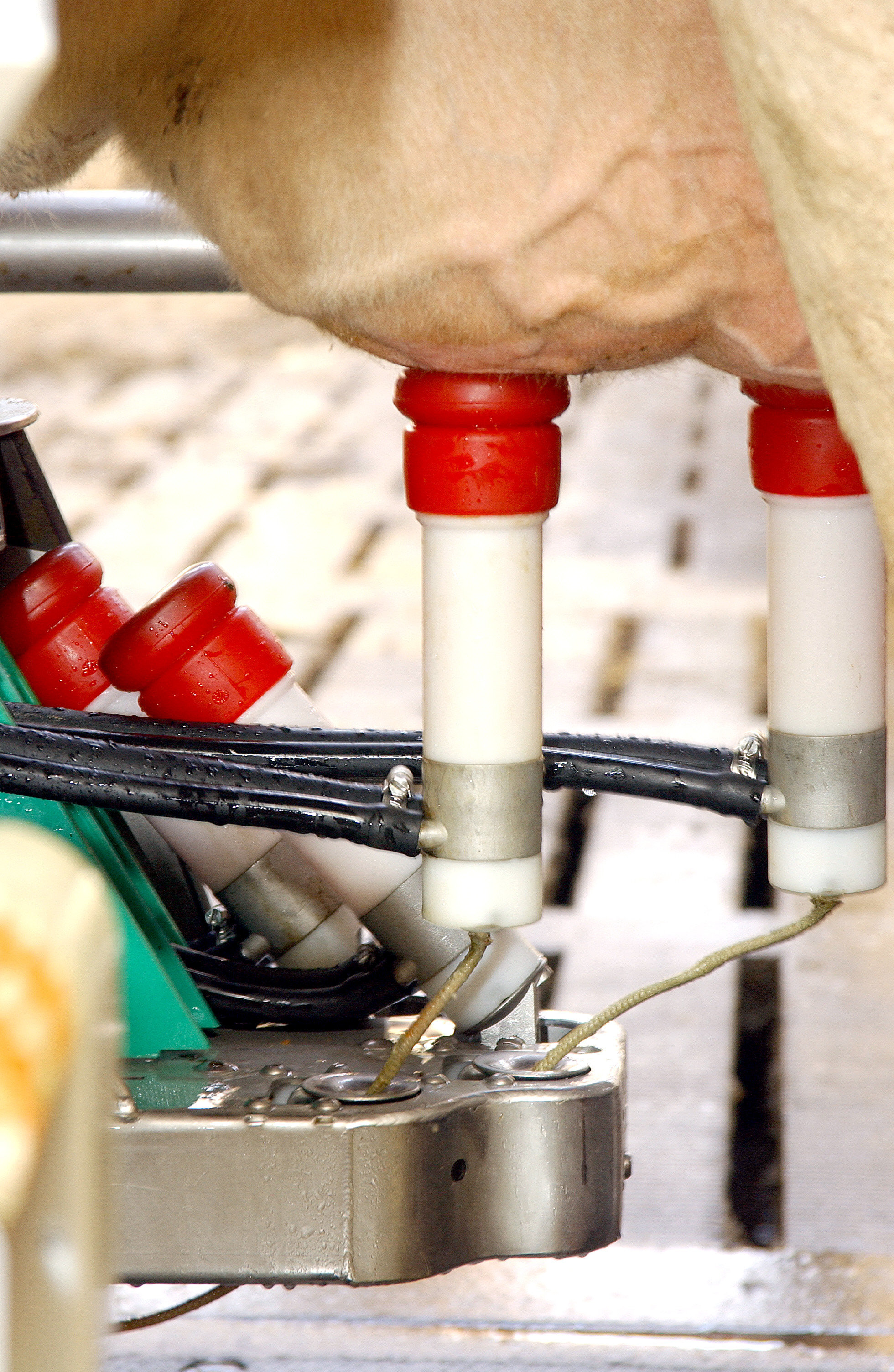
Breeding helps reduce labor and increase the return on investment in automatic milking. Selecting on the milking robot index results in more kilograms of fat and protein per robot per day, heifers that adapt to robot milking more quickly, and a shorter interval between milkings while maintaining or even improving udder health.
Ideal robot cow
Small difference, big effect
Through data exchange with thousands of milking robots, CRV has information on 3.5 billion milkings from 2.3 million automatically milked cows. This includes robot visits, total milking time, and milk production. Using this data, CRV estimates breeding values for milking robot efficiency, milking robot interval, and milking robot habituation.Milking robot efficiency is defined as milk production (corrected for fat and protein percentage) per minute of robot time. The breeding value has an average of 100. Using only bulls with a breeding value of 104 on an average cows 100 results in daughters averaging 102, translating to 0.11 kg extra milk per minute. That might seem like a small amount, but it adds up to 132 kg extra milk per robot per day and over 48,000 kg per robot per year.
Shorter milking interval, faster adaptation
Milking robot interval indicates the number of minutes between two milkings. Using bulls with a breeding value of 104 reduces this interval by nearly 15 minutes, about 0.1 extra milking per cow per day, and fewer cows that need to be fetched.Breeding for milking robot habituation also directly saves labor. The faster heifers visit the robot on their own, the less time the farmer spends guiding them. Using bulls with a breeding value of 104 results in 9 minutes less difference between the early-lactation milking interval and the later-lactation interval, meaning faster adaptation.
Maintaining udder health
To make it easier to breed robot suitable cows, CRV developed the milking robot index. It combines the breeding values for milking robot efficiency, interval, and habituation, and includes udder health.A high milking robot efficiency correlates with high milking speed, but too much speed can negatively affect udder health. Including udder health in the index prevents breeding choices that would harm udder condition.Breeding on the milking robot index results in more kilograms of fat and protein per robot, heifers that adapt faster, and shorter milking intervals, all while maintaining or even improving udder health.The greatest improvement comes from milking robot efficiency, followed by interval and habituation. Udder health is weighted less heavily but included to prevent negative effects. There is enough genetic variation among cows and bulls to make substantial progress. In the current CRV Holstein offering, about half of the bulls have a milking robot index of 104 or higher.
Select on the index, mate on conformation
Robot data analysis shows no direct relationship between the milking robot index and conformation traits such as teat placement, udder depth, or fore udder attachment. The correlation with teat length and locomotion is weak. This doesn’t mean conformation is irrelevant, extremes should still be avoided. For example, it is more difficult for the milking robot to attach rear teats that touch or cross each. The greatest labor savings and profitability gains come from selecting cows and bulls with the highest milking robot index. CRV calculates these indexes for genomic and daughter-proven red and black Holstein bulls. Marker research provides insight into female breeding values, available in HerdOptimizer. After selecting the top cows and bulls, you can avoid conformation extremes through targeted mating, for which SireMatch is a useful tool.
Three robot breeding values in one milking robot index
The milking robot index consists of:
– Milking robot efficiency
– Milking robot interval
– Milking robot habituation
– Udder health
Breeding on this index leads to more fat and protein per robot per day, faster adaptation in heifers, and shorter intervals between milkings, with stable or improved udder health.
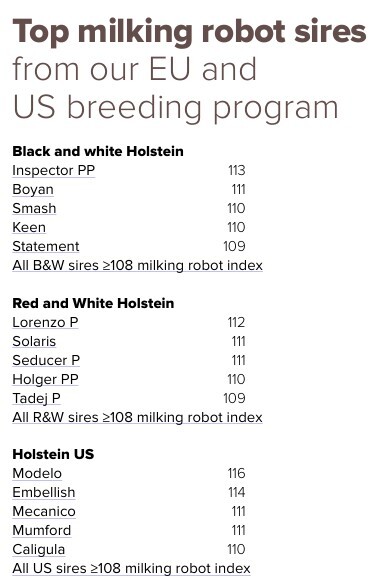
Selecting on milking robot index in the Sire directory
You can find the milking robot index of Holstein bulls in the CRV webshop. There you can also filter bulls with a high milking robot index. In the left menu, click ‘choose a breeding value’ and select ‘milking robot index’. A slider appears that you can move to set the minimum desired value. Once set, only bulls meeting that threshold will be shown.